

Interventional Care

We notice that you are visiting us from . This site only services US-based visitors. Would you like to visit the site that is appropriate for your location?
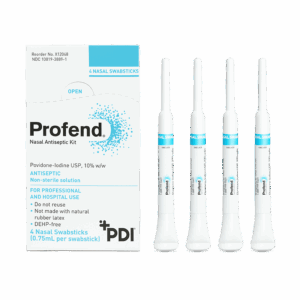
Up to 30% of healthy adults are nasally colonized with S. aureus1. 85% of S. aureus SSIs come from the patient’s own nasal flora.2 Nasal colonization with these bacteria increases the patient risk of developing an SSI by 9 times.3 To help reduce this risk, Povidone-Iodine is used as a broad spectrum antiseptic that has proven efficacy in reducing S. aureus. It offers an added advantage over the widely-used nasal antibiotic, mupirocin, in that there is no known bacterial resistance to PVP-I, thereby supporting antibiotic stewardship within the healthcare environment.
1 VandenBergh MF, Yzerman EP, van Belkum A, Boelens HA, Sijmons M, Verbrugh HA. Follow-up of Staphylococcus aureus nasal carriage after 8 years: redefining the persistent carrier state. J Clin Microbiol. 1999;37:3133–3140.
2 Septimus EJ. Nasal Decolonization: What antimicrobials are more effective prior to surgery? Am J Infect Control 2019;47S:A53-A57. doi: 10.1016/j.ajic.2019.02.028.
3 Kalmeijer MD, van Nieuw-land-Bollen E, Bogaers-Hofman D, de Baere GA. Nasal carriage of Staphylococcus aureus is a major risk factor for surgical-site infections in orthopedic surgery. Infect Control Hosp Epidemi-ol. 2000;21(15)319-323