
Thank you for visiting PDI Healthcare's US Website.

We notice that you are visiting us from . This site only services US-based visitors. Would you like to visit the site that is appropriate for your location?

*By selecting “yes” we will redirect you to and remember your choice for future visits.

« Back to results

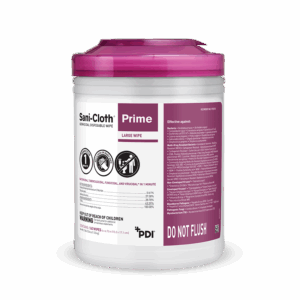
Sani-Cloth® Prime Wipes - Terminal Disinfection Video

Type: Video

Designed for Environmental Service Professionals: For new hire training or yearly refresher, this in-service video covers a basic product overview, canister preparation instructions, instructions for use and disposal information for Sani-Cloth Prime wipe.

Frequently Asked Questions

  • Can PDI Germicidal Wipes ship by air transportation?

    Show Answer
    Most Sani-Cloth® brand germicidal wipes can be shipped via air transportation. However, Sani-Cloth® Prime, Super Sani-Cloth®, Sani-Cloth® Plus, and Easy Screen® wipes cannot be shipped by air due to shipping regulations and must be transported by ground only.
  • Do PDI Germicidal Disposable Wipes contain any ingredient listed as carcinogenic?

    Show Answer
    PDI disinfectants DO NOT contain any ingredients listed as a carcinogenic by the National Toxicology Program (NTP), American Conference of Governmental Industrial Hygienists (ACGIH), and Occupational Safety and Health Administration (OSHA). To register any disinfectant product with the US Environmental Protection Agency (EPA), the manufacturer is required to provide the EPA with the product’s manufacturing process, active and inactive ingredients, efficacy, chemistry, toxicity, and information about relevant impurities. The EPA conducts a thorough review of these materials and product’s ingredients. The agency would not register any product if it contained carcinogens without requiring relevant label warnings (40 CFR 156.10(g)(7)). As such, Sani-Cloth® Wipes do not contain carcinogenic label warnings.
  • What is contact time and what happens if the surface dries before the stated contact time on a Sani-Cloth® product label?
    Show Answer
    The contact time listed on the product label is the total amount of time that it takes to inactivate ALL of the microorganisms listed on the product label. This time is typically referred to in minutes, and should be communicated to staff members that are utilizing the disinfectant. Per EPA guidance, treated surfaces must remain visibly wet for the full stated contact time in order to achieve the efficacy claims on the label. If a surface dries too quickly, additional wipes may be needed to keep the surface wet. The overall contact time itself does not change. Surfaces may sometimes dry before the stated contact time due to factors such as airflow and ventilation, temperature, humidity, or the material/porosity of the surface. This is not uncommon in healthcare environments, which often have high air exchanges and low relative humidity. While the EPA requires that treated environmental surfaces remain wet for the full contact time, some leading researchers in infection prevention have offered an alternate view. In a commentary published in Infection Control and Hospital Epidemiology (March 2018, vol. 39, no. 3, pp 229–231), Dr. W.A. Rutala and Dr. D.J. Weber suggested that contact time and treatment time are mutually exclusive, and that treatment time — regardless of visible wetness — may be sufficient for wipes (except bleach products). PDI continues to monitor this research closely and will provide customers with the latest information as regulations permit.

You're leaving PDIHC.com

You will now be redirected to

SEE COURSES NOW

@

Not recently active