
Thank you for visiting PDI Healthcare's US Website.

We notice that you are visiting us from . This site only services US-based visitors. Would you like to visit the site that is appropriate for your location?

*By selecting “yes” we will redirect you to and remember your choice for future visits.

« Back to results

Profend® Nasal Antiseptic Kit (In-Service Video)

Type: Video


For new hire training or yearly refresher, this in-service video covers a basic product overview and appropriate application of the Profend Nasal Antiseptic Kit.

Proactively defend your patients and facility today—choose quick, easy, assured protection of the Profend Nasal Antiseptic Kit.

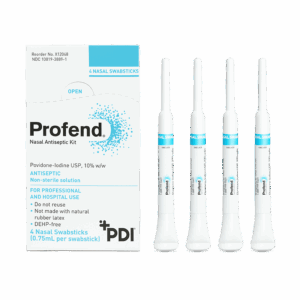
  • Uniquely designed swabsticks pre-saturated with 10% Povidone-Iodine (PVP-I)—just snap and swab.
  • Fast 60-second treatment time.
  • Neat, dry-handle design for limited mess.
  • Small nasal swab for patient comfort.
  • Kills 99.7% of S. aureus at 1 hour and 99.9% at 12 hours.*


> View Profend Product Page

 *PDI in vivo Study 0113-CTEVO.

Frequently Asked Questions

  • How is the Profend® Nasal Antiseptic Kit used?
    Show Answer
    The Profend Nasal Antiseptic Kit swabsticks are designed to be applied to the circumference of the patient's nostril and anterior nares. In total, two swabsticks are applied to each nostril for 15 seconds per swabstick. Thus, using 4 swabsticks, the total treatment time is 60 seconds.
  • What is the Profend® Nasal Antiseptic Kit?

    Show Answer
    The Profend Nasal Antiseptic Kit is a pack of four swabsticks that are pre-saturated with 10% (w/w) Povidone-Iodine antiseptic solution and are applied to the nostrils/anterior nares of the nose to proactively defend patients against Staphylococcus aureus (S. aureus), other bacteria that can cause Surgical Site Infections (SSIs), and other healthcare-acquired infections (HAIs).
  • When is the Profend® Nasal Antiseptic Kit used?
    Show Answer
    The Profend Nasal Antiseptic Kit can be used on patients who have tested positive for S. aureus. As an alternative to a “test and treat” strategy, the ease and speed of application and economical design make Profend suitable for universal decolonization of all patients as well, saving time and money spent on patient testing. Regardless of decolonization strategy, Profend has proven efficacy—in a study of healthy volunteers, the Profend Nasal Antiseptic Kit reduced S. aureus by 99.7% in just 10 minutes.* For pre-operative use, clinicians can choose to apply the product to the patient at least 10 minutes prior to surgery depending on hospital protocol. *SOURCE: 1 PDI in vivo Study 0113-CTEVO.
  • Where is the Profend® Nasal Antiseptic Kit used?
    Show Answer
    The Profend Nasal Antiseptic Kit can be used anywhere in a healthcare facility where there are patients who may be nasally colonized with S. aureus and therefore have an elevated risk of developing an SSI or other HAIs.
  • Who uses the Profend® Nasal Antiseptic Kit?

    Show Answer
    Perioperative nurses who care for patients prior to surgery and nursing staff in other areas of the hospital,ie. ICU, are the primary users of the Profend Nasal Antiseptic Kit,. Profend offers unique features valued by clinicians – a preference study showed that over 90% of nurses preferred Profend over other PVP-I nasal antiseptic products. SOURCE: PDI user acceptance study.
  • Why is the Profend® Nasal Antiseptic Kit used?

    Show Answer
    Up to 30% of healthy adults are nasally colonized with S. aureus1. 85% of S. aureus SSIs come from the patient's own nasal flora.2 Nasal colonization with these bacteria increases the patient risk of developing an SSI by 9 times.3 To help reduce this risk, Povidone-Iodine is used as a broad spectrum antiseptic that has proven efficacy in reducing S. aureus. It offers an added advantage over the widely-used nasal antibiotic, mupirocin, in that there is no known bacterial resistance to PVP-I, thereby supporting antibiotic stewardship within the healthcare environment.   1 VandenBergh MF, Yzerman EP, van Belkum A, Boelens HA, Sijmons M, Verbrugh HA. Follow-up of Staphylococcus aureus nasal carriage after 8 years: redefining the persistent carrier state. J Clin Microbiol. 1999;37:3133–3140. 2 Septimus EJ. Nasal Decolonization: What antimicrobials are more effective prior to surgery? Am J Infect Control 2019;47S:A53-A57. doi: 10.1016/j.ajic.2019.02.028. 3 Kalmeijer MD, van Nieuw-land-Bollen E, Bogaers-Hofman D, de Baere GA. Nasal carriage of Staphylococcus aureus is a major risk factor for surgical-site infections in orthopedic surgery. Infect Control Hosp Epidemi-ol. 2000;21(15)319-323

You're leaving PDIHC.com

You will now be redirected to

SEE COURSES NOW

@

Not recently active