

Interventional Care

We notice that you are visiting us from . This site only services US-based visitors. Would you like to visit the site that is appropriate for your location?
Are Sani-HyPerCide® Disinfectants effective against C. diff.?
Yes. Sani-HyPerCide® disinfectants are a ready-to-use Hydrogen Peroxide formula that is effective against Clostridioides difficle
Does PDI distribute outside of the United States?
PDI does distribute some products to countries outside of the United States. For more information, please contact Customer Care at 1-800-999-6423.
Does PDI® Lubricating Jelly contain parabens?
Yes. Parabens used in small amounts are commonly found in preservative systems for many medical and pharmaceutical grade products, and common cosmetic products, such as shampoos and conditioners.
Does PDI offer any hypoallergenic products?
The following PDI products are hypoallergenic:
– Hygea® Premium Multi-Purpose Washcloths (SKU J14143)
– Hygea Multi-Purpose Washcloths (SKUs J22750, U12095)
– Hygea Flushable Personal Cleansing Cloths (SKU A500F48)
– PDI® Unscented Baby Wipes (A62640, M41580)
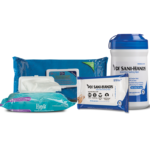
What is the expiration date on Sani-Hands® Instant Hand Sanitizing Wipes?
Sani-Hands wipes have a 24 month expiration date from the date of finished product manufacturing.
Who uses the Profend® Nasal Antiseptic Kit?
Perioperative nurses who care for patients prior to surgery and nursing staff in other areas of the hospital,ie. ICU, are the primary users of the Profend Nasal Antiseptic Kit,. Profend offers unique features valued by clinicians – a preference study showed that over 90% of nurses preferred Profend over other PVP-I nasal antiseptic products.
SOURCE: PDI user acceptance study.
Where is the Profend® Nasal Antiseptic Kit used?
The Profend Nasal Antiseptic Kit can be used anywhere in a healthcare facility where there are patients who may be nasally colonized with S. aureus and therefore have an elevated risk of developing an SSI or other HAIs.
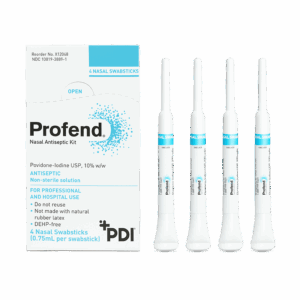
What is the Profend® Nasal Antiseptic Kit?
The Profend Nasal Antiseptic Kit is a pack of four swabsticks that are pre-saturated with 10% (w/w) Povidone-Iodine antiseptic solution and are applied to the nostrils/anterior nares of the nose to proactively defend patients against Staphylococcus aureus (S. aureus), other bacteria that can cause Surgical Site Infections (SSIs), and other healthcare-acquired infections (HAIs).
Why is the Prevantics® Device Swab solution beneficial?
By using an antiseptic to disinfect the needleless access site, you are decreasing the risk of the patient acquiring a bloodstream infection (BSI) which can be fatal to the patient. According to the CDC, “Disinfection of the devices with chlorhexidine/alcohol solution appears to be most effective in reducing colonization”.*
*2011 CDC Guidelines for the Prevention of Intravascular Catheter-Related Infections p.56.
How compatible are Easy Screen® wipes on healthcare touch screen equipment?
70% IPA is the most compatible formulation for sensitive touch screen equipment in healthcare. It is the most referenced formula in equipment manufacturer’s instructions for use. PDI has performed extensive compatibility work on touch screen materials and equipment to confirm compatibility. Easy Screen wipes are compatible with polycarbonate, glass, aluminum silicate, acrylic, stainless steel and more!
[Cleaning the screen of your mobile device with a wipe containing alcohol may reduce the lifespan of any anti-fingerprint coating. Please check your device manufacturer’s cleaning instructions.]
If I use the Prevantics® Device Swab product, will I still need to use an alcohol impregnated cap?
Not necessarily. If clinicians follow all existing infection prevention and control measures, such as hand hygiene, use of personal protective equipment, use of chlorhexidine-based skin antisepsis, etc. then the use of an alcohol impregnated cap may not be clinically indicated. This would be evaluated by ongoing surveillance of HAI rates.
What are considered “dry” sites and “wet” sites?
Dry sites are areas where there are no skin folds, such as the abdomen, back and forearm, and no evidence of moisture caused by diaphoresis. Wet sites are areas with skin folds, such as the groin area, under arms, and under breasts, as well as areas that may be moist due to diaphoresis.