

Interventional Care
We notice that you are visiting us from . This site only services US-based visitors. Would you like to visit the site that is appropriate for your location?
What’s the difference between cleaning, sanitizing, and disinfecting?
Cleaning removes dirt, debris, and some germs from surfaces. It does not kill microorganisms but reduces their numbers by physically removing them.
Sanitizing lowers the number of germs on a surface to a safe level as defined by public health standards. Sanitizers are typically used on food-contact surfaces and must be registered by the EPA for that purpose.
Disinfecting goes a step further by using EPA-registered products to kill a wide range of microorganisms on hard, non-porous surfaces when used according to label directions. Disinfectants are essential in healthcare and other high-risk environments where infection prevention is critical.
PDI’s surface disinfection brand products are EPA-registered disinfectants, designed to kill a broad spectrum of clinically relevant microorganisms, including bacteria, viruses, fungi, and (in the case of sporicidal products) spores. While they can also be used for cleaning, they are not registered as food-contact sanitizers. This means that when used on food-contact surfaces, a potable water rinse is required after disinfection.
How does HydroGuard™ technology help with material compatibility?
HydroGuard™ technology is PDI’s proprietary formulation approach designed to balance effective disinfection with enhanced material compatibility. Many disinfectants can cause cumulative wear on sensitive plastics, metals, and coatings over time. HydroGuard™ helps minimize this risk by controlling the concentration of active ingredients and incorporating stabilizers that reduce the likelihood of surface damage such as cracking, crazing, or discoloration.
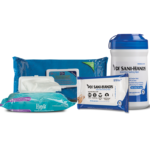
This means products with HydroGuard™ technology—like Sani-HP1™ and Sani-HyPerCide® Germicidal Wipes—can deliver broad-spectrum efficacy while being safer for use on a wide range of common healthcare materials and equipment.
Always consult PDI’s Equipment Compatibility Tool and your device manufacturer’s instructions for the most up-to-date compatibility guidance.
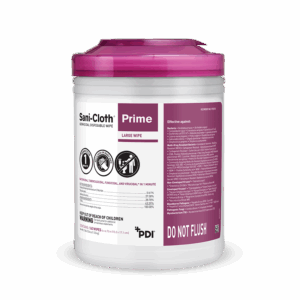
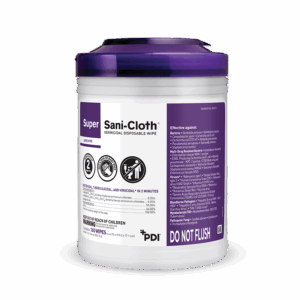
What is the difference between Super Sani-Cloth® and Sani-Cloth® Prime Germicidal Disposable Wipes?
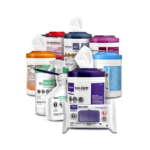
Both Super Sani-Cloth® and Sani-Cloth® Prime are everyday disinfectant wipes used for high-touch surface disinfection in healthcare. The distinction comes from their history, compatibility profile, and spectrum of efficacy:
Super Sani-Cloth — The #1 disinfectant wipe in healthcare, trusted for over 30 years for its proven material compatibility and consistent performance. It provides a 2-minute contact time and efficacy against 34 microorganisms, including Candida auris, Norovirus, and SARS-CoV-2.
Sani-Cloth Prime — Building on the legacy of Super, Prime was developed to provide broader efficacy and a faster 1-minute contact time, with claims against 54 microorganisms. It’s a great choice when expanded coverage and quick turnaround are priorities, while still maintaining compatibility.
In short: Super Sani-Cloth remains the industry standard for trusted compatibility, while Sani-Cloth Prime represents the next generation of speed and efficacy in surface disinfection.
What is the difference between Sani-HP1™ and Sani-HyPerCide® Germicidal Wipes?
Both Sani-HP1™ and Sani-HyPerCide® are hydrogen peroxide–based germicidal wipes, but they are designed to meet different facility needs:
Sani-HP1 — A daily-use surface disinfectant with a 1-minute contact time against bacteria, viruses, and fungi. It uses a low concentration of hydrogen peroxide with PDI’s HydroGuard™ technology to deliver broad efficacy while maximizing material compatibility for routine use across a wide range of healthcare equipment and surfaces.
Sani-HyPerCide — A broad-spectrum sporicidal disinfectant that can also be used for everyday disinfection. It is effective against Clostridioides difficile spores and is often chosen as a bleach alternative, providing sporicidal efficacy without the odor, residue, or compatibility concerns of bleach.
In short: Sani-HP1 is PDI’s quick, compatible choice for daily disinfection, while Sani-HyPerCide offers both routine disinfection and sporicidal efficacy, making it a strong bleach-free option for high-risk environments.
Does Easy Screen® have a contact time or EPA-registered kill claims?
No. Easy Screen® Cleaning Wipes are designed as screen and electronics cleaning wipes, not as EPA-registered disinfectants. They contain a 70% isopropyl alcohol (IPA) formula, which is the most commonly referenced concentration in equipment manufacturer cleaning instructions, but Easy Screen® does not carry EPA-registered kill claims or disinfectant contact times.
These wipes are intended to safely clean touchscreens, monitors, keyboards, and other sensitive surfaces where disinfectant products may not be recommended.
What are the ESKAPE pathogens, and which PDI products are effective against them?
The acronym ESKAPE refers to six clinically significant pathogens known for multidrug resistance and virulence: Enterococcus faecium, Staphylococcus aureus, Klebsiella pneumoniae, Acinetobacter baumannii, Pseudomonas aeruginosa, and Enterobacter species.
These organisms are considered some of the most dangerous in healthcare because they are able to “escape” the effects of commonly used antibiotics. Collectively, the ESKAPE pathogens are the leading cause of healthcare-associated infections (HAIs) in the healthcare environment.*
PDI’s Sani-HP1™, Sani-HyPerCide®, Sani-Cloth Prime, Super Sani-Cloth, Sani-Cloth AF3 and Sani-Cloth Bleach Germicidal Disposable Wipes all carry claims against all six ESKAPE pathogens.
Sani-Cloth® Plus covers five of the six, but does not have a claim against Acinetobacter baumannii.
*Mulani et al. Emerging Strategies to Combat ESKAPE Pathogens in the Era of Antimicrobial Resistance: A Review. Front Microbiol. 2019 Apr 1;10:539. doi: 10.3389/fmicb.2019.00539. PMID: 30988669; PMCID: PMC6452778.
Is PDI, Inc. a publicly traded company?
No. PDI is a privately held, third generation, family-owned company and is therefore, not publicly traded. For more information on the history of PDI, please visit the “About” section of our corporate website.
What year was PDI established?
Professional Disposables International, Inc., commonly known as PDI, Inc., was founded in 1977 as the healthcare division of Nice-Pak Products, Inc. and, in 2007, was established as a separate entity. For more information on the history of PDI, please visit the “About” section of our Corporate website.
Does PDI offer continuing education programs for medical professionals?
Yes. PDI’s Clinical Affairs team can deliver a variety of continuing education programs onsite and/or via conferencing platforms. To learn more about offerings, please reach out to ClinicalAffairs@pdipdi.com
Do PDI’s surface disinfection and cleaning products contain any ingredient listed as carcinogenic?
PDI disinfectants DO NOT contain any ingredients listed as carcinogenic by the National Toxicology Program (NTP), American Conference of Governmental Industrial Hygienists (ACGIH), and Occupational Safety and Health Administration (OSHA). This applies to ALL Sani-Cloth® products, including Sani-HyPerCide®, Sani-Cloth Prime, Super Sani-Cloth, Sani-Cloth AF3, Sani-Cloth Bleach, and Sani-Cloth Plus brands. To register any disinfectant product with the US Environmental Protection Agency (EPA), the manufacturer is required to provide the EPA with the product’s manufacturing process, active and inactive ingredients, efficacy, chemistry, toxicity, and information about relevant impurities. The EPA conducts a thorough review of these materials and product ingredients. The agency would not register any product if it contained carcinogens without requiring relevant label warnings (40 CFR 156.10(g)(7)). As such, Sani-Cloth Wipes do not contain carcinogenic label warnings.
Does PDI have clinical personnel on staff to answer any clinical questions?
Yes. PDI has a team of Clinical experts on staff to help answer questions as well as help facilities identify best practices for improving outcomes and reduce the incidence of Healthcare-associated Infections. Our clinical team also delivers clinical education, performs clinical assessments, and provides consultation on various infection prevention topics.
Where can I find my local PDI Sales Representative’s contact information?
To obtain your local PDI Sales Representative’s contact information, please click the “Find My Rep” button (in the top navigation). When prompted, enter your zip code. You can also submit an inquiry through out “Contact Us” option.