

Interventional Care

We notice that you are visiting us from . This site only services US-based visitors. Would you like to visit the site that is appropriate for your location?
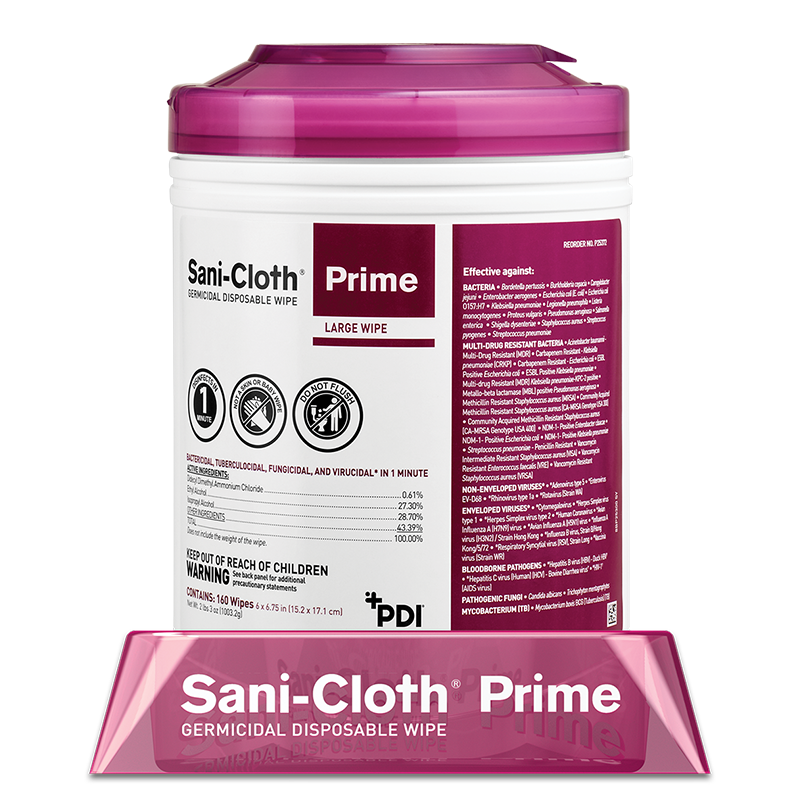
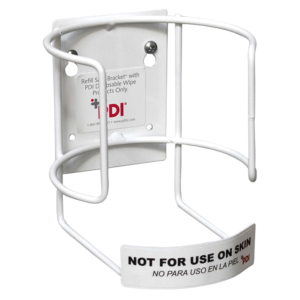
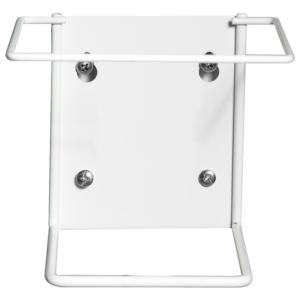
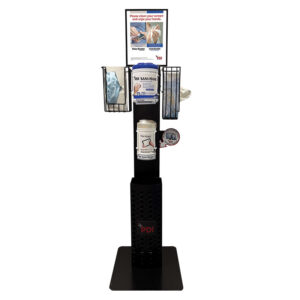
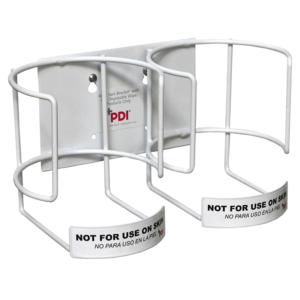
The countertop holder for canisters is perfect for nursing stations and carts. It helps display important product and compliance information, such as contact time and precautionary language.
SELECT A SIZE
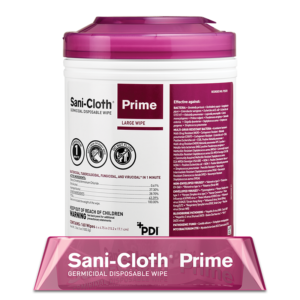
Packaging | 10/case
Dimensions | 6.5" x 6.5" x 1.5"
This instructions for use sign contains step-by-step directions on how to properly dispense and disinfect using Sani-Cloth Prime…
What is the difference between Super Sani-Cloth® and Sani-Cloth® Prime Germicidal Disposable Wipes?
Both Super Sani-Cloth® and Sani-Cloth® Prime are everyday disinfectant wipes used for high-touch surface disinfection in healthcare. The distinction comes from their history, compatibility profile, and spectrum of efficacy:
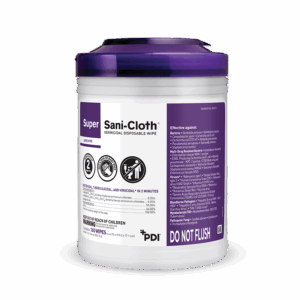
Super Sani-Cloth — The #1 disinfectant wipe in healthcare, trusted for over 30 years for its proven material compatibility and consistent performance. It provides a 2-minute contact time and efficacy against 34 microorganisms, including Candida auris, Norovirus, and SARS-CoV-2.
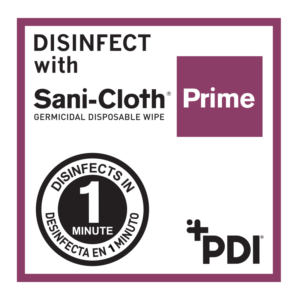
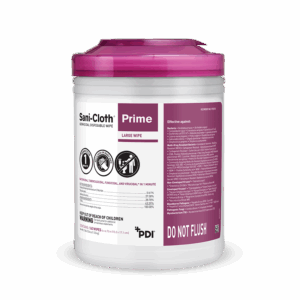
Sani-Cloth Prime — Building on the legacy of Super, Prime was developed to provide broader efficacy and a faster 1-minute contact time, with claims against 54 microorganisms. It’s a great choice when expanded coverage and quick turnaround are priorities, while still maintaining compatibility.
In short: Super Sani-Cloth remains the industry standard for trusted compatibility, while Sani-Cloth Prime represents the next generation of speed and efficacy in surface disinfection.
Are eye wash stations required for areas where Germicidal Disposable Wipes are utilized?
Eye wash stations are not required for areas where Germicidal Disposable Wipes are utilized as intended for surface disinfection. Although Super Sani-Cloth®, Sani-Cloth Prime, Sani-Cloth Bleach, Sani-HyPerCide®, Sani-Cloth AF3, and Sani-Cloth Plus are classified as eye irritants, there is no OSHA or ANSI regulation that requires an eye wash station for eye irritants and therefore one not needed for these products. Handling of any chemical product, whether category 1, 2, 3, or 4, include using PPE when required, engineering controls if appropriate, and safe work practice controls to minimize any risk of exposure
Can PDI Germicidal Wipes be used on toys?
Yes. PDI’s EPA-registered surface disinfectant products—including Super Sani-Cloth®, Sani-Cloth AF3, Sani-Cloth Bleach, Sani-Cloth Plus, Sani-Cloth Prime, Sani-HP1™, and Sani-HyPerCide® brands—are approved and labeled for use on hard, non-porous toys. They clean and disinfect in a one-step process unless the toy is visibly soiled. After disinfection, toys should always be rinsed thoroughly with potable water (tap water) and allowed to air dry.
This rinse step is not unique to PDI—it is required for all EPA-registered surface disinfectants when used on toys or items that may be mouthed, since disinfectants are not registered as food-contact surface sanitizers. Without the rinse, chemical residues could remain on items that children may put in their mouths.
According to the Association for Professionals in Infection Control and Epidemiology (APIC), recommended best practice is: “Toys should be cleaned/disinfected between patients, especially those that are visibly soiled, mouthed, or used by patients in isolation. Toys should be washed thoroughly; disinfected with a non-toxic, low-level disinfectant; and air dried completely.”
Infection prevention experts also recommend only using washable toys for sharing. Stuffed animals and toys that cannot be cleaned and disinfected should not be shared.
SOURCE: APIC Text of Infection Control and Epidemiology, Chapter 39, p. 14-15, Association for Professionals in Infection Control and Epidemiology, 2011. www.apic.org
Do you have any products effective against SARS-CoV-2 virus (the virus that causes COVID-19)?
Yes. The CDC directs users to EPA List N, which identifies EPA-registered disinfectants that meet the criteria for use against SARS-CoV-2. According to the EPA, products on List N are expected to kill all strains and variants of the virus when used according to label directions.
All PDI surface disinfectant wipes are included on List N and are effective against SARS-CoV-2.
This includes:
For the most current information, you can verify PDI products directly on the EPA List N using the EPA registration numbers found on each product label. [https://www.epa.gov/coronavirus-and-disinfectants/list-n-advanced-search-page-disinfectants-coronavirus-covid-19]
Does National Fire Protection Association (NFPA) 30 apply to PDI's surface disinfection and cleaning products?
No. The National Fire Protection Association (NFPA) 30 applies to the storage, handling, and use of flammable and combustible liquids. PDI products such as Sani-HP1™, Sani-HyPerCide® Wipes, Sani-Cloth® Prime, Super Sani-Cloth, Sani-Cloth Plus, Sani-Cloth Bleach, and Easy Screen® Cleaning Wipes are exempt from NFPA 30 requirements.
Although the liquid portion of some of these products may be classified as flammable on the SDS, the wipes themselves are not considered “liquids.” EPA classifies wipes as mixture products containing both solids and liquids, and NFPA has confirmed that wipes are not treated as liquids for the purposes of NFPA 30.
Additionally, NFPA 30 Section 9.1.4(4) specifically excludes “medicines, foodstuffs, cosmetics, and other consumer products that contain more than 50% by volume of water-miscible liquids, with the remainder of the solution not being flammable, where packaged in individual containers not exceeding 5 L (1.3 gallons).”
For these reasons, NFPA 30 does not apply to PDI disinfectant wipes. However, always verify storage requirements with your insurance carrier, as their standards may be more stringent than NFPA guidelines.
Some PDI products state "store at room temperature." What is the definition of room temperature?
For our EPA-regulated products, such as Sani-Cloth® AF3, Super Sani-Cloth, Sani-Cloth Bleach, Sani-Cloth Plus. Sani-Cloth Prime, Sani-HyPerCide® and Sani-HP1™ brand products, room temperature within a temperature range of 20◦ to 25◦ C (68◦ – 77◦ F) degree for room temperature and within a temperature range of 15◦ C to 30◦ C (59◦ F to 86◦ F). For our FDA-regulated products, such as Prevantics® brand products, “controlled room temperature” indicates a temperature maintained thermostatically that encompasses the usual customary working environment of 20◦ C to 25◦ C (68◦ F to 77◦ F).
SOURCE: USP 41-NF 36 General Notices and Requirements (August 1, 2013 First Supplements) Section 10.30.50. “Room Temperature” indicates the temperature prevailing in a working area. Section 10.30.60. Controlled Room Temperature
What are the ESKAPE pathogens, and which PDI products are effective against them?
The acronym ESKAPE refers to six clinically significant pathogens known for multidrug resistance and virulence: Enterococcus faecium, Staphylococcus aureus, Klebsiella pneumoniae, Acinetobacter baumannii, Pseudomonas aeruginosa, and Enterobacter species.
These organisms are considered some of the most dangerous in healthcare because they are able to “escape” the effects of commonly used antibiotics. Collectively, the ESKAPE pathogens are the leading cause of healthcare-associated infections (HAIs) in the healthcare environment.*
PDI’s Sani-HP1™, Sani-HyPerCide®, Sani-Cloth Prime, Super Sani-Cloth, Sani-Cloth AF3 and Sani-Cloth Bleach Germicidal Disposable Wipes all carry claims against all six ESKAPE pathogens.
Sani-Cloth® Plus covers five of the six, but does not have a claim against Acinetobacter baumannii.
*Mulani et al. Emerging Strategies to Combat ESKAPE Pathogens in the Era of Antimicrobial Resistance: A Review. Front Microbiol. 2019 Apr 1;10:539. doi: 10.3389/fmicb.2019.00539. PMID: 30988669; PMCID: PMC6452778.
What are the levels of disinfection for PDI EPA-Registered products?
All of PDI’s Sani-Cloth® brand products are EPA-registered and meet or exceed CDC recommendations for cleaning and disinfection in healthcare facilities.
Products with an efficacy claim against Mycobacterium bovis (Tuberculosis) are classified as intermediate-level disinfectants.
This includes:
Products without a Tuberculosis claim are classified as low-level disinfectants, including: