Thank you for visiting PDI Healthcare's US Website.

We notice that you are visiting us from . This site only services US-based visitors. Would you like to visit the site that is appropriate for your location?

*By selecting “yes” we will redirect you to and remember your choice for future visits.

« Back to results

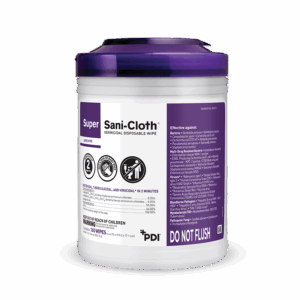
Super Sani-Cloth® Disinfecting Wipes In-Service Training Video (Canisters)

Type: Video

For new hire training or yearly refresher, this in-service video covers a basic product overview, canister preparation instructions, instructions for use, and disposal information for Super Sani-Cloth Disinfecting Wipes (Canisters)

Fast contact time allows for a quick room turnover. Ideal for daily use in fast-paced environments that require short contact times and broad coverage of microorganisms.

  • Alcohol/Quat disinfectant formulation.
  • EPA-registered intermediate level disinfectant.
  • Cleans and disinfects in one step.
  • Bactericidal, Tuberculocidal, Virucidal.
  • Compatible with a broad range of surfaces and equipment in healthcare.


> View Super Sani-Cloth Product Page

Frequently Asked Questions

  • Can Sani-Cloth® Germicidal Disposable Wipes be used on toys?

    Show Answer
    Sani-Cloth wipes are available in EPA-Registered formulations that are approved and labeled for use on hard, non-porous toys. The products clean and disinfect in a one-step process, unless visibly soiled. Once disinfected, toys should be rinsed with potable water (tap water) to remove any residue and allowed to air dry. According to the Association for Professionals in Infection Control and Epidemiology (APIC), the recommended procedure for disinfecting toys is "Toys should be cleaned/disinfected between patients, especially those that are visibly soiled, mouthed, or used by patients in isolation. Toys should be washed thoroughly; disinfected with a non-toxic, low-level disinfectant and air dried completely." Infection control experts recommend only washable toys for sharing. Stuffed animals and toys that cannot be cleaned and disinfected should not be shared.

    SOURCE: APIC Text of Infection Control and Epidemiology, Chapter 39, p. 14-15, Association for Professionals in Infection Control and Epidemiology, 2011. www.apic.org

  • Do PDI Germicidal Disposable Wipes contain any ingredient listed as carcinogenic?

    Show Answer
    PDI disinfectants DO NOT contain any ingredients listed as a carcinogenic by the National Toxicology Program (NTP), American Conference of Governmental Industrial Hygienists (ACGIH), and Occupational Safety and Health Administration (OSHA). To register any disinfectant product with the US Environmental Protection Agency (EPA), the manufacturer is required to provide the EPA with the product’s manufacturing process, active and inactive ingredients, efficacy, chemistry, toxicity, and information about relevant impurities. The EPA conducts a thorough review of these materials and product’s ingredients. The agency would not register any product if it contained carcinogens without requiring relevant label warnings (40 CFR 156.10(g)(7)). As such, Sani-Cloth® Wipes do not contain carcinogenic label warnings.
  • What are the levels of disinfection for PDI EPA-Registered products?

    Show Answer
    All of PDI’s Sani-Cloth® brand products are EPA-registered and meet or exceed CDC recommendations for cleaning and disinfection in healthcare facilities. Products with an efficacy claim against Mycobacterium bovis (Tuberculosis) are classified as intermediate-level disinfectants. This includes:
    • Sani-HP1™ Germicidal Disposable Wipes (EPA Reg. No. 9480-17)
    • Sani-HyPerCide® Germicidal Wipes (EPA Reg. No. 9480-16)
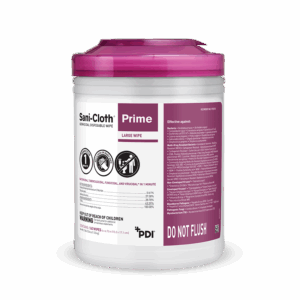
    • Sani-Cloth Prime Germicidal Disposable Wipes (EPA Reg. No. 9480-12)
    • Sani-Cloth AF3 Germicidal Disposable Wipes (EPA Reg. No. 9480-9)
    • Super Sani-Cloth Germicidal Disposable Wipes (EPA Reg. No. 9480-4)
    • Sani-Cloth Bleach Germicidal Disposable Wipes (EPA Reg. No. 9480-8)
    Products without a Tuberculosis claim are classified as low-level disinfectants, including:
    • Sani-Cloth Plus Germicidal Disposable Wipes (EPA Reg. No. 9480-6)
  • What is contact time and what happens if the surface dries before the stated contact time on a Sani-Cloth® product label?

    Show Answer
    The contact time listed on the product label is the total amount of time that it takes to inactivate ALL of the microorganisms listed on the product label. This time is typically referred to in minutes, and should be communicated to staff members that are utilizing the disinfectant. Per EPA guidance, treated surfaces must remain visibly wet for the full stated contact time in order to achieve the efficacy claims on the label. If a surface dries too quickly, additional wipes may be needed to keep the surface wet. The overall contact time itself does not change. Surfaces may sometimes dry before the stated contact time due to factors such as airflow and ventilation, temperature, humidity, or the material/porosity of the surface. This is not uncommon in healthcare environments, which often have high air exchanges and low relative humidity. While the EPA requires that treated environmental surfaces remain wet for the full contact time, some leading researchers in infection prevention have offered an alternate view. In a commentary published in Infection Control and Hospital Epidemiology (March 2018, vol. 39, no. 3, pp 229–231), Dr. W.A. Rutala and Dr. D.J. Weber suggested that contact time and treatment time are mutually exclusive, and that treatment time — regardless of visible wetness — may be sufficient for wipes (except bleach products). PDI continues to monitor this research closely and will provide customers with the latest information as regulations permit.
  • What personal protective equipment (PPE) is required when using PDI Germicidal Wipes?

    Show Answer
    For all PDI products, according to the label instruction, the use of gloves or other PPE may not be required to handle the product, particularly in non-clinical settings. Therefore, the routine use of PPE is not required unless potentially infectious blood or bodily fluids are present or if specifically referenced in the usage instructions. If bloodborne pathogens are present, such as HIV, HBV, and HCV, follow label instructions. You should, however, wear PPE as appropriate in accordance with your facility protocol. Also, in compliance with good industrial and health hygiene, you should wear gloves when cleaning and disinfecting in a patient setting.
  • Where can I find the expiration date for PDI's Germicidal Wipes?
    Show Answer
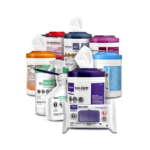
    The expiration date is stamped directly on each product in MM/YYYY format. Shelf life varies by formulation:
    • Sani-Cloth® AF3, Super Sani-Cloth®, Sani-Cloth® Plus, and Easy Screen®: 24 months from date of manufacture
    • Sani-Cloth® Prime, Sani-HyPerCide® and Sani-HP1™: 12 months from date of manufacture
    • Sani-Cloth® Bleach: 11 months from date of manufacture
    Products can be used until the printed expiration date.

You're leaving PDIHC.com

You will now be redirected to

SEE COURSES NOW

@

Not recently active