

Interventional Care

We notice that you are visiting us from . This site only services US-based visitors. Would you like to visit the site that is appropriate for your location?
We are here to support you every step of the way!
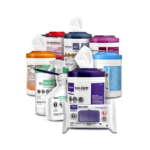
How should I dispose of or recycle my PDI wipe canister?
PDI recommends disposing of all products in accordance with applicable local, state, and federal regulations.
If residual liquid remains in the canister, do not intentionally dispose of the liquid into sinks or drains unless permitted by your facility’s environmental policies and applicable regulations. Because disposal requirements may vary, follow your facility’s established waste management procedures and applicable local, state, and federal requirements. Consult the product label and Safety Data Sheet (SDS) for additional handling and disposal information, as applicable.
Once the canister is empty, the remaining wipes and container may be disposed of according to your facility’s standard waste management procedures. Empty containers may be recyclable where accepted by local recycling programs. Please check your local recycling program’s acceptance criteria, as recycling capabilities vary by municipality and facility.
Understanding Hantavirus Pathogen – FAQs
What is the Hantavirus Pathogen?
• Hantaviruses are group of viruses that can cause severe illness and death1.
• Incubation period is 4 to 42 days after exposure; median of 18 days1.
• Hantaviruses can cause hantavirus pulmonary syndrome (HPS) that affects the lungs and the case fatality rate can be approximately 38%1.
• In the US, hantavirus is most commonly spread to humans through contact with infected rodents.
• The Andes variant of hantavirus is endemic to South America and is spread by rodents with the potential for person-to-person transmission.
• Symptoms of HPS include fatigue, fever, muscle aches, headaches, dizziness, chills, nausea/vomiting/ diarrhea/abdominal pain1.
What is the current situation surrounding the Hantavirus?
• The World Health Organization (WHO) was notified on May 2, 2026 of a cluster of severe acute respiratory illness among cruise ship passengers and crew that was laboratory confirmed hantavirus, Andes virus strain. As of May 8, WHO reported 8 cases, including 3 deaths. The cruise ship departed from Argentina
on April 1, 2026 and traveled across the South Atlantic Ocean. (https://www.cdc.gov/han/php/notices/han00528.html)
How does the Hantavirus spread?
• In the U.S., hantavirus is most commonly spread to humans through contact with infected rodents.
• Andes virus strain of hantavirus is the only strain with known person-to-person transmission via close, prolonged contact with a symptomatic individual. This includes time spent in enclosed spaces, exposure to the infected person’s saliva, respiratory secretions, or other body fluids.
What are some CDC precautions and infection control measures?
• Environmental Exposure: Avoid exposure to rodents/rodent droppings, wet cleaning and disinfection practices with appropriate PPE use, use of an EPA registered disinfectant in accordance with CDC recommendations2.
• Person-to-Person Exposure (specific to Andes virus): frequent hand washing, avoid close contact with exposed or infected individuals (avoid sharing drinks, eating utensils, food sharing)2.
Does PDI offer disinfection solutions against Hantavirus?
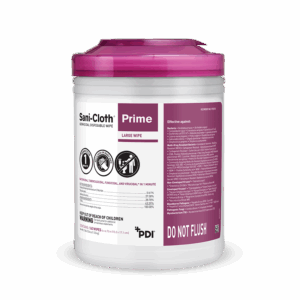
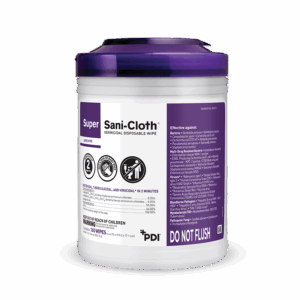
• No. PDI products do not carry specific EPA-approved efficacy claims against Hantavirus. However, several PDI disinfectant wipes — including Sani-Cloth® Prime, Super Sani-Cloth®, Sani-Cloth® Bleach, Sani-Cloth® AF3, Sani-HP1™, and Sani-Hypercide® — have efficacy claims against enveloped viruses and should be used according to EPA-approved label directions and CDC guidance.
References
1 https://www.cdc.gov/han/php/notices/han00528.html; https://www.cdc.gov/hantavirus/faq/index.html; https://www.cdc.gov/hantavirus/about/andesvirus.html
2 https://www.cdc.gov/hantavirus/about/andesvirus.html#cdc_disease_basics_causes_risk_spread-how-it-spreads; https://www.cdc.gov/healthy-pets/rodent-control/clean-up.html
What is the difference between the Prevantics Skin Antiseptic Swab (purple) and the Prevantics Device Swab (green)?
While both products are composed of the same ingredients and use the same swab component, they require separate labeling. The two products have different indications and different directions for use. The Prevantics Skin Antiseptics swab is a drug and is intended for use on the skin whereas the Prevantics Device Swab is a medical device intended for use on needleless access sites.
Do PDI Unscented Baby Wipes contain parabens?
No. All PDI Unscented Baby Wipes are paraben-free.
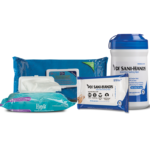
How long should I apply Sani-Hands® Instant Hand Sanitizing Wipes to the hands?
A contact time of 15 seconds provides a 99.99% reduction.*
*Reference is Data on File (C0211)
Are Sani-Hands® Instant Hand Sanitizing Wipes an FDA regulated product?
Sani-Hands Instant Hand Sanitizing Wipes are regulated by the US FDA as an OTC (Over-the-Counter) drug product marketed under section 505G(a)(3).
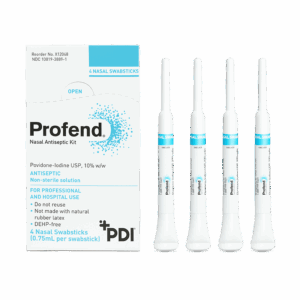
When is the Profend® Nasal Antiseptic Kit used?
The Profend Nasal Antiseptic Kit can be used on patients who have tested positive for S. aureus. As an alternative to a “test and treat” strategy, the ease and speed of application and economical design make Profend suitable for universal decolonization of all patients as well, saving time and money spent on patient testing. Regardless of decolonization strategy, Profend has proven efficacy—in a study of healthy volunteers, the Profend Nasal Antiseptic Kit reduced S. aureus by 99.7% in just 10 minutes.* For pre-operative use, clinicians can choose to apply the product to the patient at least 10 minutes prior to surgery depending on hospital protocol.
*SOURCE: 1 PDI in vivo Study 0113-CTEVO.
How is the Profend® Nasal Antiseptic Kit used?
The Profend Nasal Antiseptic Kit swabsticks are designed to be applied to the circumference of the patient’s nostril and anterior nares. In total, two swabsticks are applied to each nostril for 15 seconds per swabstick. Thus, using 4 swabsticks, the total treatment time is 60 seconds.
Why is the Profend® Nasal Antiseptic Kit used?
Up to 30% of healthy adults are nasally colonized with S. aureus1. 85% of S. aureus SSIs come from the patient’s own nasal flora.2 Nasal colonization with these bacteria increases the patient risk of developing an SSI by 9 times.3 To help reduce this risk, Povidone-Iodine is used as a broad spectrum antiseptic that has proven efficacy in reducing S. aureus. It offers an added advantage over the widely-used nasal antibiotic, mupirocin, in that there is no known bacterial resistance to PVP-I, thereby supporting antibiotic stewardship within the healthcare environment.
1 VandenBergh MF, Yzerman EP, van Belkum A, Boelens HA, Sijmons M, Verbrugh HA. Follow-up of Staphylococcus aureus nasal carriage after 8 years: redefining the persistent carrier state. J Clin Microbiol. 1999;37:3133–3140.
2 Septimus EJ. Nasal Decolonization: What antimicrobials are more effective prior to surgery? Am J Infect Control 2019;47S:A53-A57. doi: 10.1016/j.ajic.2019.02.028.
3 Kalmeijer MD, van Nieuw-land-Bollen E, Bogaers-Hofman D, de Baere GA. Nasal carriage of Staphylococcus aureus is a major risk factor for surgical-site infections in orthopedic surgery. Infect Control Hosp Epidemi-ol. 2000;21(15)319-323
Where is Prevantics® Device Swab used?
Prevantics Device Swab can be used on needleless access sites—such as needleless ports, hubs, and connectors— which are used on vascular access devices including central venous catheters, PICC lines, midlines, and peripheral IVs.